
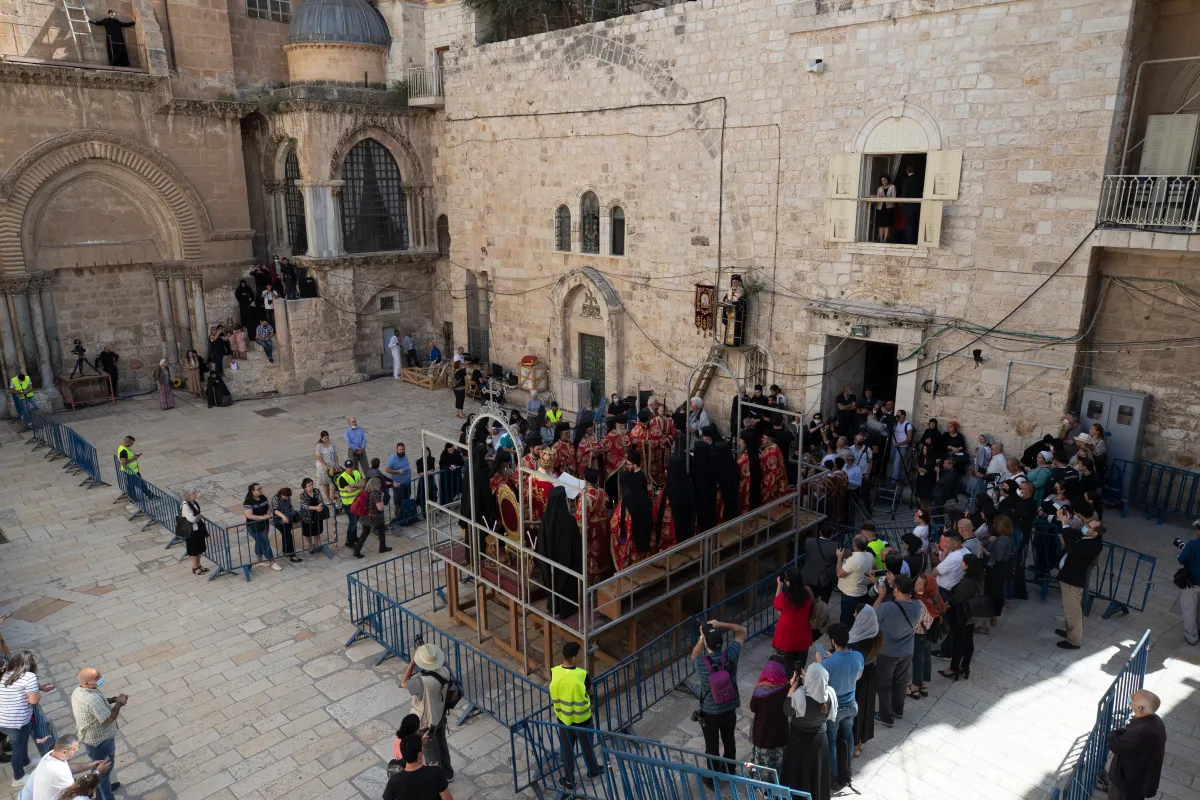
Archaeologists have uncovered signs of an ancient burial site and cultivated land beneath the Church of the Holy Sepulchre in Jerusalem, as stated by the excavation’s leader, which may enhance the site’s association with biblical narratives regarding the burial of Jesus Christ.
Francesca Romana Stasolla from Sapienza University of Rome informed the Daily Mail this week, “We have discovered indications of a funerary landscape, along with small sections cultivated with vines and olive trees.”
These remarks provide fresh insights from an excavation that commenced in 2022 during the restoration of the church’s flooring and is expected to conclude in 2025. Researchers have recorded an abandoned quarry that was subsequently utilized for agricultural purposes and rock-cut burials, features that align with the landscape depicted in the New Testament, as noted in a preliminary excavation report from 2025 published in the journal Liber Annuus.
According to the Gospel of John, a garden was located near the crucifixion site, which housed “a new tomb, in which no one had ever been laid.”
The research is gaining renewed interest following the 2026 release of the first volume in a planned series that documents the excavation. This project outlines the site’s evolution “from quarry and garden to imperial basilica and global pilgrimage center.”
In their 2025 preliminary report, Stasolla and her team detailed multiple phases of limestone extraction, followed by attempts to level and repurpose the bedrock.
Some quarry cavities were reported to reach depths of approximately 20 feet before being filled with soil, as per MailOnline. Additionally, a separate archaeobotanical study conducted by researchers from Sapienza University analyzed samples from four locations, identifying cereals, figs, and other cultivated or wild plants. The team also recorded olive wood and pollen from various herbaceous species.
Researchers have traced the later history of a burial chamber to the redevelopment of Jerusalem under Roman Emperor Hadrian in the second century, during which a Roman structure obstructed access to it. Approximately two centuries later, workers under Emperor Constantine dismantled that construction and separated the chamber from the surrounding rock, enabling it to become the focal point of a Christian shrine.
The 2023 report from the Sapienza team provided additional evidence of this early Christian transformation. Archaeologists discovered the apse of the original church and a Roman street beneath it, aiding in the reconstruction of how the area evolved prior to the construction of Constantine’s basilica in the fourth century.
The construction suggests that the chamber had been designated for Christian veneration by the time of Constantine’s reign, although it does not determine when worshippers first recognized it or confirm who was buried there.
These discoveries offer archaeological support for the physical context described in the Gospels, although they do not confirm that Jesus was buried at this site. The importance lies in the combination of the location, its use for burials, and its later preservation as a site of Christian worship.
A preliminary report from Sapienza University in 2025 indicated that the excavation enabled researchers to create the first comprehensive topographical reconstruction of the complex and to document the development of the location through its Roman and early Christian phases.
The integration of the chamber into Constantine’s fourth-century basilica further illustrates that Christians were venerating it during that time. While it does not confirm whether the tradition can be traced back continuously to the first century, it does provide evidence of an early and intentional effort to maintain the site.
“Regardless of one’s belief in the historicity of the Holy Sepulchre, the fact that generations of individuals have believed in it is an objective reality,” Stasolla remarked to The Times.