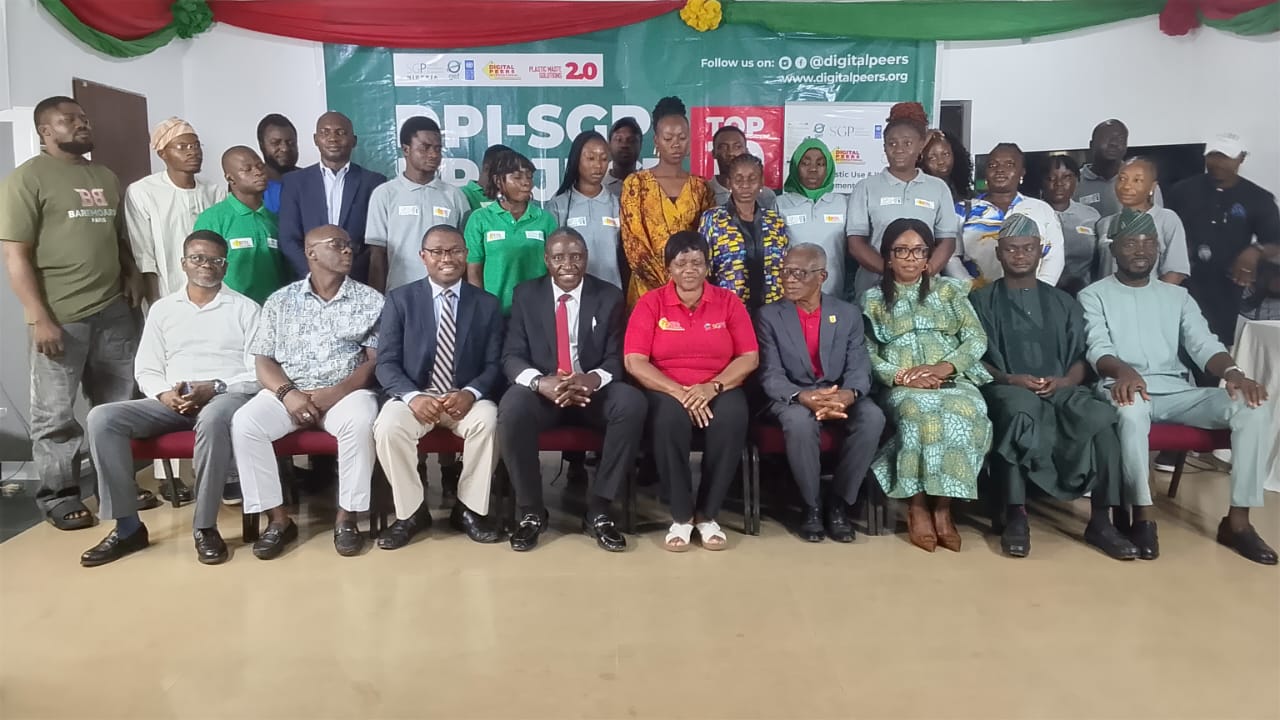
The Federal Government, along with the United Nations Development Programme, UNDP, and Digital Peers International, DPI, has reaffirmed its dedication to fostering youth-led innovation, advancing digital technology, and establishing partnerships aimed at addressing plastic pollution and enhancing Nigeria’s circular economy.
This commitment was reiterated on Monday in Abuja during the conclusion of the Plastic Waste Solutions 2.0 Project, which is supported by the Global Environment Facility Small Grants Programme and implemented by DPI in collaboration with UNDP.
Mr. Umaru Murtala, the Senior Scientific Officer at the Department of Pollution Control and Environmental Health within the Federal Ministry of Environment, stated that the ministry provided essential technical guidance and policy support throughout the project’s implementation.
Murtala characterized the initiative as one of the most significant youth-oriented environmental programs endorsed by the ministry, highlighting that participants were able to create technology-based solutions despite initially lacking digital skills.
In a virtual address, Dr. Ibironke Olubamise, the National Coordinator of the UNDP GEF-SGP, noted that the project empowered numerous young Nigerians with practical knowledge and digital skills necessary to address plastic waste.
Olubamise emphasized that the initiative exemplified UNDP’s conviction that sustainable environmental solutions are most effective when they are community-driven, locally owned, and reinforced through strategic partnerships among key development stakeholders across the nation.
She remarked, “Young individuals have been equipped with practical knowledge and skills to develop innovative solutions, while digital platforms have been established to facilitate environmental education and activities related to the circular economy.”
According to her, the project produced valuable research and evidence to inform future environmental initiatives, and many of the innovations created by the participating youth demonstrated significant potential for commercial success.
She highlighted the necessity for ongoing investment, mentorship, and enterprise development to facilitate the transition of innovations from prototypes to scalable businesses that can generate employment and provide environmental advantages.
Olubamise emphasized the significance of recording lessons learned through the project’s knowledge management process to enhance future environmental initiatives and improve implementation results nationwide.
“As we progress, maintaining the achievements of this project will necessitate ongoing collaboration among government entities, development partners, the private sector, and local communities.
“It is essential that young people, who are central to this initiative, remain actively involved,” she stated.
In addition, Dr. Ibukun Odusote, Chief Executive Officer of DPI, remarked that the conclusion of the project marks the commencement of a larger endeavor to establish a sustainable innovation ecosystem.
Odusote noted that the true indicator of success would be the capacity of innovations created by participants to evolve into sustainable enterprises that generate jobs and address environmental issues.
“Our success will not be gauged merely by the number of activities completed.
“It will be assessed by the extent to which these ideas develop into market-ready solutions that have an impact beyond the duration of the project,” she added.
According to her, the initiative intentionally concentrated on establishing long-term systems through institutional enhancement, digital innovation, and youth empowerment, rather than depending on short-term measures.
She revealed that the innovation challenge garnered 46 proposals from young Nigerians, with the most promising ideas surfacing after thorough technical assessments conducted by experts from diverse fields.
Odusote further stated that DPI would implement a structured innovation support program that offers mentorship, business development services, prototype refinement, and investment readiness coaching for young innovators across the nation.
She mentioned that the program would also provide assistance with enterprise registration, product testing, market access opportunities, and strategic partnerships to aid participants in successfully commercializing their innovations.
Odusote expressed her belief that many beneficiaries would rise as leaders in Nigeria’s expanding green economy, making significant contributions to environmental sustainability and inclusive economic growth.
She emphasized the Green Genius App and Eco Trade Hub created under the project, pointing out that both platforms would persist in promoting environmental education and activities related to the circular economy.
Odusote urged for enhanced collaboration with government entities to amplify innovations that can transform plastic waste into construction materials and other value-added products throughout the country.
“Our duty now is to build upon these foundations through innovation, ongoing collaboration, and investment.
“This project has not only addressed the environmental issues of today; it has laid the groundwork for the solutions of tomorrow,” she stated.