
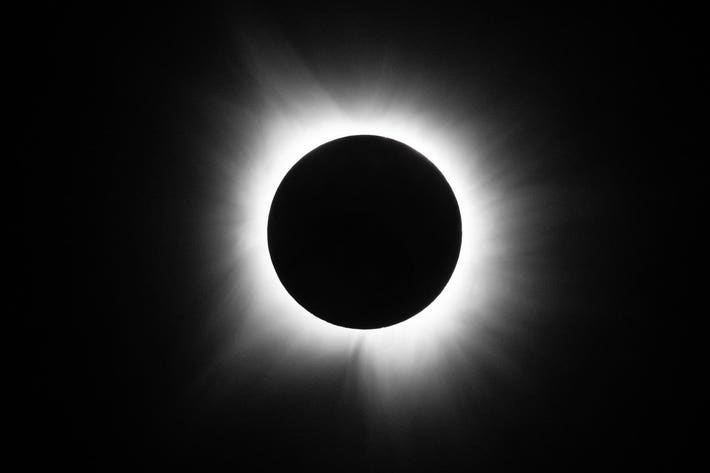
A rare and magnificent total solar eclipse is approaching in just a few weeks. On Wednesday, August 12, 2026, the moon’s central shadow will traverse the Arctic, eastern Greenland, western Iceland, the Atlantic Ocean, and northern Spain, with a small section of Portugal also included in the path.
For those positioned correctly, daylight will momentarily diminish, the sun’s corona will become visible, and eclipse glasses may be removed — but only during the period of totality. During totality, observers may even witness the northern lights and ‘shooting stars.’ Here is all the essential information regarding the upcoming total solar eclipse.
Totality will last for a maximum of 2 minutes and 18 seconds, with the longest duration occurring near Iceland. In Spain, totality will take place just before sunset, while Greenland will serve as another significant viewing site.
This will mark the first total solar eclipse observable from Iceland since 1954 and from Spain since 1905. Mainland Europe has not experienced a total solar eclipse since 1999.
A partial solar eclipse will be visible across much of Europe, northwestern Africa, Canada, and parts of the northern United States.
August 12 also coincides with the peak of the annual Perseids meteor shower, during which up to 100 ‘shooting stars’ may be visible each hour.
A total solar eclipse occurs when the moon moves directly between the Earth and the sun, completely obscuring the sun’s bright disk. This alignment is feasible because the sun is approximately 400 times larger than the moon, yet also about 400 times farther away, resulting in their apparent equal size in the sky.
Total solar eclipses take place somewhere on Earth approximately every 16 months; however, they are exceedingly rare at any specific location, often reappearing only once every few centuries.
Numerous expedition cruise ships will transport eclipse enthusiasts to Greenland, with the most favorable land-based locations found in western Iceland (where the aurora can be observed at night starting from mid-August) and northern Spain (which is ideally situated for viewing the Perseids). In Iceland, totality will traverse the west coast during the early evening, while Spain will witness a total solar eclipse appearing low in the northwestern sky just before sunset.
The path concludes just east of the Balearic Islands. In both Spain and the Balearic Islands, eclipse enthusiasts will seek clear skies and open landscapes, including coastlines, plateaus, and elevated vantage points with views low on the northwestern horizon. The most optimal viewing conditions are anticipated in Castile and León, La Rioja, Aragón, and the Balearic Islands.
Ten locations to observe the 2026 total solar eclipse
Below are ten locations to witness the 2026 total solar eclipse in eastern Greenland, western Iceland, and northern Spain.
Scoresby Sund, Greenland (totality lasting up to 2 minutes 17 seconds)
Snæfellsnes Peninsula, Iceland (totality lasting 2 minutes 9 seconds)
Reykjavík, Iceland (totality lasting 1 minute).
Reykjanes Peninsula, Iceland (totality lasting up to 1 minute 46 seconds)
La Coruña, Spain (1 minute 16 seconds)
León, Spain (1 minute 44 seconds)
Burgos, Spain (1 minute 44 seconds)
Zaragoza, Spain (1 minute 22 seconds)
Ebro Delta, Spain (1 minute 36 seconds)
S’Arenal, Mallorca, Spain (1 minute 35 seconds)
Guidelines for Safe Viewing
A total solar eclipse presents two distinct sets of viewing guidelines. During the partial phases, it is imperative to wear eclipse glasses or utilize certified solar filters at all times. Only during the phase of totality, when the moon entirely obscures the sun, is it permissible to observe without eye protection and witness the corona — the sun’s delicate outer atmosphere — with the naked eye. Once totality concludes, it is essential to put the eclipse glasses back on.
Recent and Upcoming Total Solar Eclipses in the U.S.
The most recent total solar eclipse occurred on April 8, 2024, allowing for up to 4 minutes and 28 seconds of totality along a narrow path that traversed Mexico, the U.S., and Canada. The subsequent total solar eclipse in the U.S. is scheduled for March 30, 2033, in Alaska, while the next one visible from the contiguous United States will take place on August 23, 2044. Following that, another significant coast-to-coast eclipse in the U.S. is anticipated on August 12, 2045.