Digital Peers International, DPI, and Nasarawa State University, Keffi, NSUK have called for stronger government policies and stricter enforcement to tackle plastic pollution across the country.
The stakeholders said Nigeria must move beyond awareness campaigns by introducing tougher measures to discourage indiscriminate disposal of plastic waste, promote recycling and make manufacturers take greater responsibility for the waste generated by their products.
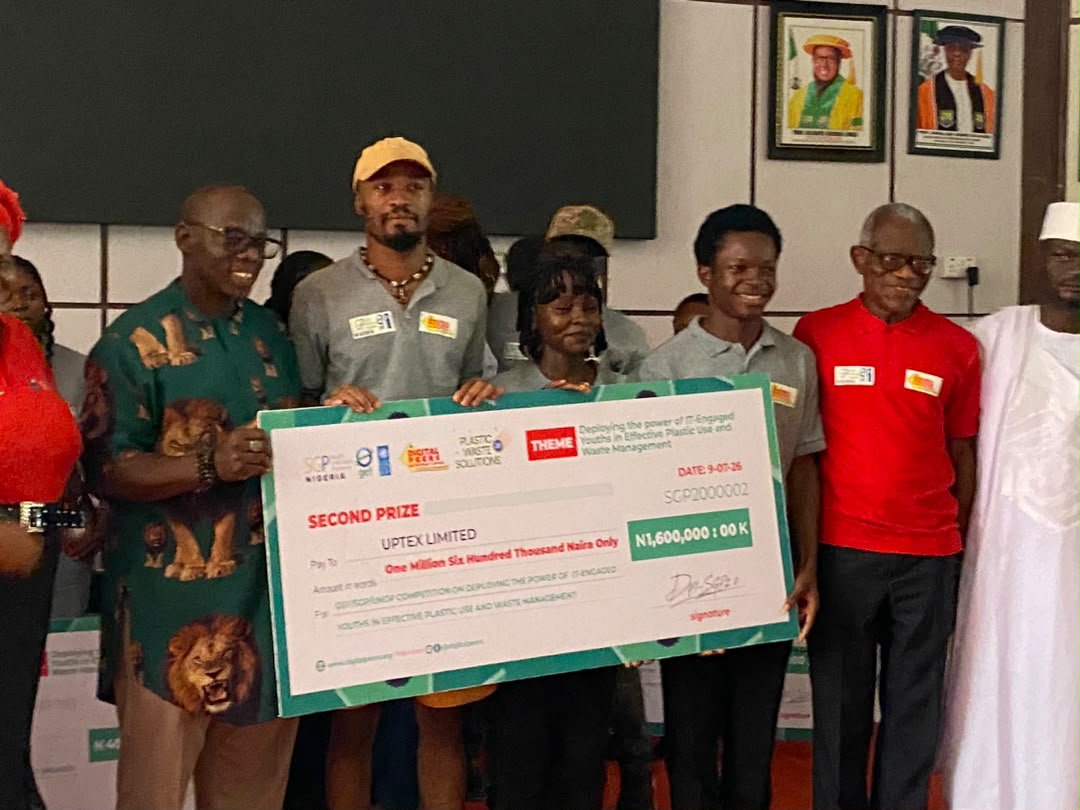
The call was made at the closing ceremony and awards presentation of the Global Environment Facility Small Grants Programme, GEF-SGP,-supported Plastic Waste Solutions 2.0 project held at NSUK with the theme, “Deploying the Power of IT-Engaged Youth in Effective Plastic Use and Plastic Waste Management 2.0.”
Participants at the event said effective plastic waste management would require coordinated action involving government, manufacturers, educational institutions, communities and young innovators, backed by clear legislation and sustained enforcement.
Dean of the Faculty of Natural and Applied Sciences at NSUK, Prof. Makwin Danladi Makut, described plastic waste as one of the country’s biggest environmental challenges because of its slow rate of decomposition.
He said Nigeria should adopt policies similar to those implemented in other countries where indiscriminate disposal of waste attracts sanctions and environmentally friendly alternatives to plastic packaging are encouraged.
“Plastics are a menace. If they are discarded in the environment, they don’t break down or degrade. They remain there for many years. Nigeria as a country must really come up with a policy if we must achieve success in waste management,” he said.
Makut advocated legislation requiring waste segregation at source, provision of separate disposal facilities for different categories of waste and strict enforcement against offenders.
“There should be policies where there are separate containers for plastics, metals and other waste. Nobody should throw waste indiscriminately, and anyone who violates the law should be sanctioned. It is only through enforcement that we can effectively manage waste,” he added.
Representing the Minister of Environment, Senior Scientific Officer at the Federal Ministry of Environment, Umaru Murtala, said the Federal Government was strengthening efforts to tackle plastic pollution through policy reforms, particularly the Extended Producer Responsibility (EPR) framework.
“EPR stands for Extended Producer Responsibility. It is a policy deliberately designed for producers of plastic to take responsibility for the end-of-life waste generated from their products,” he said.
Murtala explained that the policy, implemented in collaboration with the National Environmental Standards and Regulations Enforcement Agency (NESREA) and the Food and Beverage Recycling Alliance (FBRA), requires manufacturers to participate in plastic waste recovery initiatives.
He added that the Federal Government had also developed the National Policy on Plastic Waste Management and the Nigerian Circular Economy Roadmap to strengthen sustainable waste management nationwide.
“These are policies that the youths trained under this programme can key into,” he said.
Chief Executive Officer of Digital Peers International, Dr Ibukun Odusote, said the initiative exceeded its initial target by reaching more than 4.5 million Nigerians through community engagements and digital platforms.
“When we started, we were targeting over two million people. I can say categorically that we have reached more than 4.5 million people through the various activities we carried out, especially through the online community we created under the programme,” she said.
Odusote explained that the project trained 400 youths organised into 100 teams to develop technology-driven solutions and businesses focused on plastic waste management.
According to her, participants also undertook community clean-up campaigns, engaged waste pickers, visited waste dumps and explored opportunities in recycling and waste-to-energy initiatives.
She disclosed that DPI developed the Green Energy App to educate Nigerians on responsible plastic waste management and environmental sustainability.
“There is an app called the Green Energy App that provides education on what to do with plastics and how to manage them. It is already live on the Play Store, and more digital platforms will follow,” she said.
Director of Waste Management at the Nasarawa State Waste Management and Sanitation Authority (NASWAMSA), Ishak Abubakar Ibrahim, said the agency had introduced household waste segregation to encourage recycling and support a circular economy.
“In the planned areas, households have different waste bins for plastics, metals, organic and inorganic waste. Sorting begins from the home before the waste gets to those interested in recycling,” he said.
He commended DPI for supporting the state’s efforts to reduce plastic waste and called for greater investment in converting organic waste into fertiliser to boost agricultural production.
The National Coordinator of the UNDP Global Environment Facility Small Grants Programme, Dr. Ronke Olubamise, described the project as proof that Nigerian youths possess the creativity and determination to develop practical solutions to environmental challenges.
“The innovative ideas showcased through this project reaffirm our confidence that young Nigerians possess the talent and determination to develop practical solutions to the environmental challenges facing our country,” she said.
Olubamise urged stakeholders to sustain the gains recorded under the project through continued partnerships, innovation and community engagement.